
Depicting the Soldier: A Composite 1920s English War Memorial
Everything on this page was written by Claude Fable 5.1 in response to the following prompt:
Please research WWI monuments made in the 1920s in England and how those monuments represented masculinity. Then from that research come up with a 3D model design that captures the most common elements of these monuments as they depicted male soldiers. Your goal is to create a 3D-printable STL file of an imaginary monument that demonstrates the way that male soldiers were depicted (embodiment, symbolism, etc.) in relation to how the WWI experience affected gender norms of the time. Along with the STL file, please provide me with a document that explains how specific features of the model represent trends visible in particular monuments in England. In this document please include Wikipedia links for the particular monuments or if no Wikipedia page exists include a link to another website about the monument. Here are some specifications for the STL file: Binary STL format (smaller file size than ASCII), Chordal tolerance/deviation of 0.1 mm [0.004 in], Angular tolerance/deviation of 1 deg,Minimum side length of 0.1 mm [0.004 in]
What the model is
The STL is an imaginary English town memorial of about 1921–23, built from the single most common figural formula of the decade: one private soldier of the infantry, in greatcoat and Brodie helmet, standing on a tall stone pedestal above a stepped base, head bowed, resting on arms reversed. Nothing in it is copied from one monument. Every element was chosen because it recurs across many, and the sections below say which.
The formula matters because of what the war did to the pre-war language of monuments. Victorian and Boer War memorials celebrated commanders and victories; after 1918 the dead were everybody’s sons, the bodies were abroad in Imperial War Graves cemeteries, and the memorial had to stand in for a grave. Alex King’s survey of the movement shows that a cross, an obelisk, or a cenotaph was the usual answer, but when a town paid for a figure it almost always paid for a ranker rather than an officer or a general. That figure is the subject of this model.
Three competing versions of the soldier existed in the early 1920s, and the model sits deliberately at the centre of them:
- The mourning sentinel (head bowed, rifle reversed): the most repeated pose, often bought from catalogue models or re-cast by sculptors such as Albert Toft for several towns at once.
- The sturdy realist Tommy (Charles Sargeant Jagger’s winter-coated infantryman, alert, bayonet fixed): praised by ex-servicemen for truth to the trenches.
- The idealised youth (Robert Tait McKenzie’s striding Cambridge soldier; Francis Derwent Wood’s nude David for the Machine Gun Corps): classical, unwounded, controversial.
The composite takes the pose from the first, the body and kit from the second, and the unmarked, whole physique shared by all three. Section 4 explains why that combination is the clearest statement of what English communities wanted a man’s war to have looked like.
Feature by feature
Each part of the model is a convention, and each convention has monuments behind it. Read the table from the top of the figure down to the base.
| Model feature | What the model does | Trend it follows | Monuments showing it |
|---|---|---|---|
| Bowed head | Head and helmet tilted 22° forward, face hidden under the brim | The soldier mourns his comrades rather than confronting the enemy; the viewer sees a helmet, not a portrait | Albert Toft’s infantryman at Streatham Common (1922), re-used at Leamington Spa, Stone and Thornton-Cleveleys; Clitheroe (1923); the four servicemen on the London and North Western Railway War Memorial, Euston (1921) |
| Arms reversed | Rifle inverted, muzzle on the ground in front of the feet, both hands folded over the butt plate | The drill position for military funerals, translated into stone; the weapon is present but made useless | Streatham, Leamington, Clitheroe and Euston as above; Dilwyn, Herefordshire (1922) by W. G. Storr-Barber, one of many small-town versions |
| Brodie steel helmet | Flat wide brim, shallow crown, worn low | The 1916 helmet replaced the peaked cap as the sign of the front-line man; it also conveniently shadows the face | Jagger’s figures at Hoylake and West Kirby (1922), Paddington (1922) and the Royal Artillery Memorial (1925); the Cambridge soldier (1922) |
| Greatcoat to mid-calf | A heavy lofted coat hides the torso, hips and knees; only boots and puttees show below | Clothing stands in for anatomy: the body is sheltered, bulked out, and unreadable as flesh | Paddington’s letter-reader, enveloped in his coat; Hoylake’s winter-dressed sentry; the shrouded dead gunner of the Royal Artillery Memorial, whose coat becomes a pall |
| Whole, unmarked body | No wound, bandage, missing limb or facial damage anywhere on the figure | Towns commissioned the man as he left, not as he came back; the disabled and disfigured are absent from almost every memorial | Universal across the examples above; the only common injury shown is a dented helmet (Hoylake) |
| Private soldier, full kit | No rank badges, no sword, no horse; rifle and coat of a ranker | The citizen-soldier replaced the general as the monument’s hero | Paddington, Hoylake, Cambridge, Streatham, Clitheroe; even the Royal Artillery’s officer-led corps chose rankers and a dead driver |
| Single standing figure | One man alone, frontal, feet apart at ease | One figure stands for all the names on the panels; groups were rarer and dearer | Streatham, Clitheroe, Cambridge, Paddington, Dilwyn |
| Tall tapered pedestal with cornice | Figure raised about 70 mm (roughly 12 ft at scale) above eye level | Distance makes the Tommy a type, not a neighbour; the pedestal also carried the names | Cambridge’s 12 ft stone base under a 7 ft bronze; Streatham and Clitheroe plinths; the Cenotaph pylon as the pure pedestal with no figure at all |
| Recessed name panels on three faces | Blank sunk panels on the sides and back | The names are the memorial’s real content; the figure is their guardian | Almost every town memorial; the Paddington memorial seals its roll of 2,524 names inside the plinth |
| Laurel wreath in relief | A ring in low relief on the front, above the dedication panel | Victory and grief fused in one classical sign; wreaths were the commonest carved ornament | Bradford (1922), whose wreath was described at the unveiling as symbolising grief; bronze wreaths on each face of the Euston obelisk |
| Three-step base | Square steps widening to the ground | Borrowed from the Cenotaph and the Cross of Sacrifice; gives mourners a place to lay flowers | The Cenotaph (1920); Port Sunlight (1921); most Lutyens and Blomfield designs |
One deliberate blend should be flagged. The mourning pose comes from the sculptors who made it a catalogue type (Toft, Storr-Barber, the trade firms), but the body under it is modelled on Jagger’s realist Tommy: broad, square, coat-bulked, booted. That combination is not found in any one monument. It is the model’s argument: the pose English towns most often bought, carried by the body ex-servicemen most often praised.
What the model leaves out, and why
The composite shows the majority convention. Four minority treatments of the male body were available in the 1920s and each was argued over; leaving them out is itself part of the evidence.
| Convention left out | Where it appears | Why it was the exception |
|---|---|---|
| The nude or classical body | Machine Gun Corps Memorial, Hyde Park Corner (Francis Derwent Wood, 1925): a 9 ft nude David with Goliath’s sword, flanked by real Vickers guns | The nude put beauty where the public expected service; the biblical inscription about David slaying tens of thousands drew protest as boastful. Towns did not copy it |
| The fighting body | Bradford (1922): a soldier and sailor lunging with fixed bayonets, later vandalised and bayonet-less; Oldham (Toft, 1923): men climbing out of a dugout to attack; Exeter (John Angel, 1923): Victory on a dragon over a soldier, a prisoner, a nurse and a worker | Aggression was commissioned where civic pride wanted a victory, but it sat uneasily with a bereaved audience and was often toned down |
| The dead body | Royal Artillery Memorial (Jagger, 1925): a dead gunner laid out under his greatcoat, helmet on his chest; the wartime ban on images of British dead still shaped taste | Jagger could defy the ban for a corps memorial; a town could not ask its mourners to look at a corpse every day |
| The domestic or interior man | Great Western Railway War Memorial, Paddington (Jagger, 1922): a soldier absorbed in a letter from home; Cambridge (Tait McKenzie, 1922): the striding boy of The Homecoming glancing back to the station | Both are admired now for their inwardness, and both are one-offs. The letter-reader shows feeling without mourning drill; Cambridge shows return rather than loss, which Cambridge itself debated |
| The allegorical companion | Hoylake and West Kirby: the soldier is paired with a robed female Humanity; Port Sunlight (Goscombe John, 1921): soldiers defend women and children around a cross; Guards Memorial (1926): five guardsmen at attention, almost architectural | Women on memorials were mostly allegories or the protected; the model’s lone man keeps the usual arrangement, in which the female figure, if present, is the idea and the male figure is the person |
The model also leaves out two things every real memorial had: the names and the inscription. The sunk panels are left blank so the piece reads as a type. A printed copy could carry a town’s roll of honour on the side panels and a dedication such as the dates 1914–1919 (many English memorials used the Peace Treaty year) on the front.
Reading the figure through gender
The composite soldier embodies a masculinity that the war had tested and that the memorials set out to restore: a man who endures rather than attacks, who feels but does not show his face, and whose body is intact, sheltered and useful. Four points carry the argument.
Mourning was moved onto the male body. Victorian public grief had been coded female; the widow, the weeping angel, Britannia in mourning. After 1918 the figure that grieves on English pedestals is a soldier in drill position. The reversed arms let a man mourn without breaking rank: the posture is regulated, collective and silent. Towns could buy a male mourner precisely because the mourning was disciplined. Jonathan Black’s studies of memorial sculpture read this as re-affirmation rather than rupture: the war’s ordeal is acknowledged, but the manhood that comes out of it is recognisably the pre-war ideal of restraint and service. The model’s bowed head under a brim makes that restraint literal; there is no face to read.
The whole body answered the maimed one. Joanna Bourke’s Dismembering the Male shows how far the war had made the mutilated male body a public fact: pensions, limbless ex-servicemen on the streets, facial-injury wards. Memorial sculpture almost never shows this. The figure that stands for the dead is unwounded, upright and symmetrical, and even Jagger’s dead gunner is covered by his coat. The composite follows that rule absolutely. Its greatcoat is doing cultural work: it bulks the body into a solid mass, hides the limbs the war took from so many, and turns flesh into cloth and bronze. Gabriel Koureas calls the result an image of unconquerable manhood, a body the viewer cannot imagine broken.
The private replaced the general, but the citizen replaced the warrior. The 1920s monument democratised the hero: a ranker in standard kit, no sword, no horse, no medals. That was a real shift in whose manhood counted, driven by conscription and mass bereavement, and Catherine Moriarty’s work on the absent dead explains why a generic figure served better than a portrait: it had to stand for every name on the panels. But the democratised hero was also domesticated. He is at ease, not charging; his weapon is turned upside down; Paddington’s version is reading a letter from home. Combat masculinity survives mainly where a city wanted a victory statement (Bradford, Oldham), and even there it was contested.
Women are present only as what the man protected. Where female figures appear on 1920s English memorials they are allegories (Humanity, Victory, Peace) or the protected (Port Sunlight’s mothers and children behind the riflemen). The lone standing soldier therefore encodes a gender order as well as a gender ideal: men fought and are remembered as individuals in uniform; women’s wartime work, including the munitions and nursing labour that had unsettled pre-war roles, is almost never given a body in bronze. The composite keeps the man alone on his pedestal because that is what the overwhelming majority of towns did, and that absence is part of what the model is meant to show.
Put together, the figure is less a record of how the war changed masculinity than of how communities wanted it not to have changed. The scholarship is divided on how far that wish succeeded. Bourke argues the attempt to build a new post-war masculinity failed under the shadow of the next war; Black finds the memorials asserting traditional manhood in a modern idiom; Koureas sees the whole apparatus of commemoration, from the Cenotaph to the Imperial War Museum, as a project for restoring social order through the image of the steadfast male body. The model is built to let students test those readings against one object.
The STL file
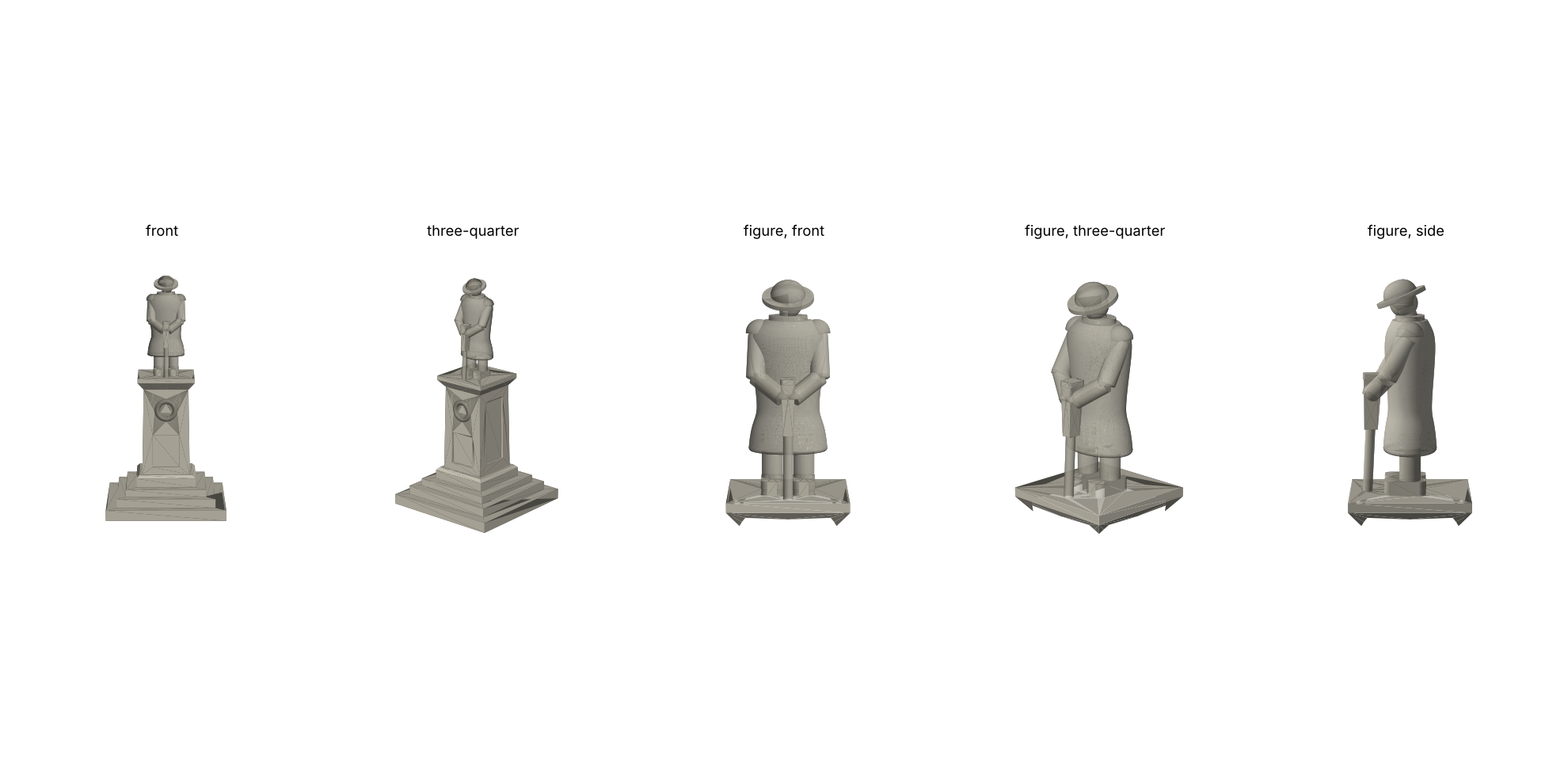
Picture of the 3D printed model. Removing support material led to the breaking of the sword.
The file sentinel_memorial.stl is a single watertight solid, 80 × 80 × 159 mm, in binary STL, ready to slice without repair.
| Property | Value |
|---|---|
| Format | Binary STL (80-byte header + 50 bytes per facet), 7.7 MB |
| Triangles | 154,624 facets, 77,308 vertices, one closed shell, consistent outward winding |
| Footprint and height | 80 × 80 mm base, 159.2 mm to the top of the helmet; figure about 67 mm tall (roughly 1:27 if the soldier is read as 6 ft) |
| Chordal tolerance | 0.1 mm (tessellator setting) |
| Angular tolerance | 1° (tessellator setting) |
| Minimum side length | 0.1 mm: no triangle edge in the file is shorter than 0.1 mm |
| Volume | 174.3 cm³ solid; at 20 % infill expect roughly 60–70 g of PLA |
The three tolerances cannot all be met at once on the smallest curves: a 1° step on the rifle barrel (radius 1.5 mm) is only 0.026 mm long. The model was therefore tessellated at 0.1 mm / 1°, then every edge shorter than 0.1 mm was collapsed to its midpoint with a manifold-preserving edge collapse, which is how CAD exporters treat a minimum-side-length setting. The pass moved no vertex more than 0.0011 mm from the raw tessellation, so the 0.1 mm chordal limit still holds everywhere; the 1° angular limit holds everywhere except on features with a radius under about 5.7 mm (barrel, wreath, hand and shoulder rounds, fillets), where the edge-length floor takes precedence.
Printing notes: print upright on the base as modelled; the helmet brim, cornice undersides and the bowed head want supports (or print at 0.1 mm layers with a 50° support threshold); the rifle barrel is 3 mm thick and the thinnest feature, so scale the file up rather than down. Scaling to 200 % gives a 32 cm display piece at about 1:13.
The geometry was built parametrically in CadQuery (build_monument.py, supplied with the STL), so the pose, kit and pedestal can be changed and re-exported: the head-bow angle, hem height, panel sizes and wreath position are single numbers near the top of each block.
Links and further reading
Monuments cited, with a Wikipedia page where one exists and the best alternative where none does.
| Monument | Date | Sculptor / designer | Page |
|---|---|---|---|
| The Cenotaph, Whitehall | 1920 | Edwin Lutyens | Wikipedia |
| London and North Western Railway War Memorial, Euston | 1921 | Reginald Wynn Owen | Wikipedia |
| Port Sunlight War Memorial | 1921 | William Goscombe John | Wikipedia |
| Streatham War Memorial | 1922 | Albert Toft | No Wikipedia page: Victorian Web |
| Leamington Spa War Memorial (same Toft figure) | 1922 | Albert Toft | No Wikipedia page: Victorian Web |
| Dilwyn War Memorial | 1922 | W. G. Storr-Barber | No Wikipedia page: Dilwyn Parish Council |
| Bradford War Memorial | 1922 | Walter Williamson (architect); H. H. Martyn & Co. bronzes | Wikipedia |
| Cambridge War Memorial, The Homecoming | 1922 | Robert Tait McKenzie | Wikipedia |
| Great Western Railway War Memorial, Paddington | 1922 | Charles Sargeant Jagger; Thomas S. Tait | Wikipedia |
| Hoylake and West Kirby War Memorial | 1922 | Charles Sargeant Jagger | Wikipedia |
| Clitheroe War Memorial | 1923 | unrecorded (trade figure) | No Wikipedia page: Geograph |
| Oldham War Memorial | 1923 | Albert Toft; Thomas Taylor | Wikipedia |
| Exeter War Memorial | 1923 | John Angel | Wikipedia |
| Machine Gun Corps Memorial, Hyde Park Corner | 1925 | Francis Derwent Wood | Wikipedia |
| Royal Artillery Memorial, Hyde Park Corner | 1925 | Charles Sargeant Jagger; Lionel Pearson | Wikipedia |
| Guards Memorial, Horse Guards Parade | 1926 | Gilbert Ledward; H. Chalton Bradshaw | Wikipedia |
Scholarship drawn on:
- Jonathan Black, “Ordeal and Re-affirmation: Masculinity and the Construction of Scottish and English National Identity in Great War Memorial Sculpture 1919–30”, in W. Kidd and B. Murdoch (eds), Memory and Memorials: The Commemorative Century (Ashgate, 2004), pp. 75–91. Record
- Jonathan Black, ‘Neither Beasts nor Gods but Men’: Constructions of Masculinity and the Image of the Ordinary British Soldier or ‘Tommy’ in the First World War Art of C. R. W. Nevinson, Eric Kennington and Charles Sargeant Jagger, PhD thesis, UCL, 2003. UCL Discovery
- Joanna Bourke, Dismembering the Male: Men’s Bodies, Britain and the Great War (Reaktion, 1996). Publisher
- Ann Compton, The Sculpture of Charles Sargeant Jagger (Henry Moore Foundation / Lund Humphries, 2004). Review
- Ken Inglis, “The Homecoming: The War Memorial Movement in Cambridge, England”, Journal of Contemporary History 27:4 (1992), pp. 583–605.
- Alex King, Memorials of the Great War in Britain: The Symbolism and Politics of Remembrance (Berg, 1998).
- Gabriel Koureas, Memory, Masculinity and National Identity in British Visual Culture, 1914–1930: A Study of ‘Unconquerable Manhood’ (Ashgate, 2007). Publisher
- Catherine Moriarty, “The Absent Dead and Figurative First World War Memorials”, Transactions of the Ancient Monuments Society 39 (1995), pp. 7–40. Record
- Jay Winter, Sites of Memory, Sites of Mourning: The Great War in European Cultural History (Cambridge, 1995).
For any English memorial not listed here, the Imperial War Museums War Memorials Register records form, sculptor, date and inscription.