
Bodies of the Fallen: Masculinity in German WWI Memorials of the 1920s and an Imaginary Monument Design
Everything on this page was written by Claude Fable 5.1 in response to the following prompt:
Please research WWI monuments made in the 1920s in Germany and how those monuments represented masculinity. Then from that research come up with a 3D model design that captures the most common elements of these monuments as they depicted male soldiers. Your goal is to create a 3D-printable STL file of an imaginary monument that demonstrates the way that male soldiers were depicted (embodiment, symbolism, etc.) in relation to how the WWI experience affected gender norms of the time. Along with the STL file, please provide me with a document that explains how specific features of the model represent trends visible in particular monuments in Germany. In this document please include Wikipedia links for the particular monuments or if no Wikipedia page exists include a link to another website about the monument. Here are some specifications for the STL file: Binary STL format (smaller file size than ASCII), Chordal tolerance/deviation of 0.1 mm [0.004 in], Angular tolerance/deviation of 1 deg,Minimum side length of 0.1 mm [0.004 in]
Scope and argument
The imaginary monument modelled in the accompanying STL file (kriegerdenkmal_1920s.stl) condenses the most frequent ways German First World War memorials of the 1920s depicted the male soldier: a stoic, whole, helmeted body standing watch over a sleeping (not mutilated) dead comrade, on a stepped plinth bearing an Iron Cross, dates and a wreath. Each feature of the model is tied below to specific German monuments (with Wikipedia or other links) and to the scholarship on how defeat, mass death and the return of disabled veterans destabilised pre-war gender norms.
Scope: memorials erected, unveiled or designed in Germany (Weimar Republic borders) between 1919 and roughly 1931. A few earlier or later works (Lehmbruck 1915–16, Kollwitz 1932, Kuöhl 1936) appear only as comparison points. Where a monument has no Wikipedia article, a museum, city or documentation site is linked instead.
Historical context: defeat, the cult of the fallen, and masculinity under strain
German memorials of the 1920s had to commemorate roughly two million dead and 2.7 million wounded without a victory to justify them, and the dominant answer was to make the male body itself the meaning. George Mosse called this the “Myth of the War Experience”: the fallen were recast as sacrificial heroes whose death was a resurrection for the nation, and the memorial was the shrine of that civic religion (Fallen Soldiers, 1990). Sabine Behrenbeck and Meinhold Lurz trace the German variant of this cult: because the Empire and its army had dissolved, the memorials substituted a small, portable set of symbols (Iron Cross, steel helmet, sword, oak and laurel) for national insignia, and often placed the monument at the church rather than the market square.
The war also destabilised the model of manhood the memorials wanted to celebrate. Roughly 1.5 million disabled veterans, many amputees or facially mutilated, were visible in every town; shell shock (“Kriegszitterer”) was widely read as failed masculinity; and the Dolchstoß legend recast the survivors as betrayed rather than beaten. Historians such as Sabine Kienitz (on the war-disabled body), Thomas Kühne (on Kameradschaft as the core of soldierly masculinity), Karen Hagemann and Ute Frevert (on the citizen-soldier and “Wehrhaftigkeit”), and Klaus Theweleit (on the armoured body of the Freikorps imagination) show that the hard, intact, self-controlled male body of the memorials was a counter-image to what people actually saw on the street. Weimar memorials, in other words, do not describe the soldier of 1914–18; they repair him.
Three overlapping stages are visible across the decade. Around 1919–1923 the emphasis was mourning and the fallen as sleeping or resurrected dead, with medieval and Christian figures common. From the mid-1920s, as the Stahlhelm veterans’ league and regimental associations became the main donors, the figures hardened into the stoic sentry, the clenched fist and the heavy greatcoat, a shift that Lurz and Loretana de Libero read as revanchist “defiance”. After 1930, and fully after 1933, the marching Sturmtrupp took over (Kuöhl’s Hamburg block of 1936 is the endpoint). The model below is anchored in the middle stage, roughly 1923–1929, which is where the largest number of surviving figural memorials in Germany sit.
Recurring motifs in 1920s German memorials
Six ways of showing the soldier’s body recur across the decade; the table gives, for each, what the body is made to do, named German examples, and the gender reading the scholarship attaches to it. Regional surveys agree that after the Iron Cross the steel helmet is the most frequent symbol on these memorials (Denk Mal! Schleswig-Holstein), and that around 1920 medieval and Christian figures dominated before giving way to dying, mourning and finally combative soldiers (Kriegerdenkmäler in Deutschland, Altenburg survey).
| Motif | What the male body does | German examples (year, artist) | Gender reading |
|---|---|---|---|
| The sentry (Wehrmann, Wacht) | Stands upright, feet planted, hands on a grounded sword or rifle, gaze fixed ahead, face expressionless | Münster, Schlossgarten “Stehender Soldat” (1923, Alexander Frerichmann); Plön, Bieberhöhe (1925, Bernhard Butzke); Berlin-Mariendorf (1923, Hermann Möller); Pfinztal-Berghausen (late 1920s, Karl Seckinger) | Self-control and Wehrhaftigkeit: the surviving male body as the guarantee that the nation is still defended; Münster’s inscription tells the reader to keep sword and honour bright |
| The clenched fist (Trotz) | Same stance, but one oversized hand balled into a fist | Berlin-Kreuzberg, Baerwaldstraße (1924); Stuttgart-Feuerbach (1929); Hüllhorst (1930); Plön (1925, above); the list is compiled in the Weinheimer Kriegerdenkmal article | Loretana de Libero reads the fist as the impotence of the defeated turned into resolve and revenge; masculinity as suppressed rage |
| The sleeping dead (Totenschlaf) | Lies supine on a bier or slab, whole and unwounded, helmet on, hands crossed or at the sides | Munich, Kriegerdenkmal im Hofgarten (1924–28, statue by Bernhard Bleeker); recumbent-soldier types in the Palatinate such as Höheinöd (Rheinpfalz survey) | Death without mutilation: the corpse is a peaceful, intact young man, a direct denial of what the Materialschlacht did to bodies (Mosse’s “masking of death”) |
| Heroic nudity and the antique/medieval warrior | Naked or half-naked, muscular, with sword, shield or spear; sometimes only the steel helmet marks him as modern | Hamburg-Altona, 31er-Denkmal (1925, figures by August Henneberger); Münster, Dreizehner-Denkmal (1923–25, Heinrich Bäumer, nude warrior resting on a sword beside a laurelled helmet); nude riders with steel helmets at Dahn (Fritz Korter) and Mannheim-Waldhof (Franz Gelb) (Rheinpfalz survey) | Timeless, individual, man-to-man combat replaces the anonymous industrial killing; the body as classical ideal (Mosse; Stefan Goebel on medievalism) |
| Comradeship (Kameradschaft) | One soldier supports, carries or kneels beside a dying or dead comrade; often the John 15:13 inscription | Weselberg and Höheinöd (Palatinate), Münchweiler (kneeling soldier, Wilhelm Schulte, before 1920) (Rheinpfalz survey); Burg (Spreewald) (relief of a coated soldier with helmet removed, rifle in hand) | Thomas Kühne: comradeship let men show tenderness and grief without loss of manhood, because it stayed inside an all-male, military frame |
| The symbol set in place of a figure | Steel helmet on oak leaves, Iron Cross, sword, laurel or oak wreath, dates 1914–1918 | Village stones at Teutschenthal (helmet on oak relief, 1920s); the Iron Cross in a laurel wreath on the Münster plinth (1923) | The helmet stands in for the male head, the sword for male agency; the nation is absent (no eagle, no crown) because the Empire had fallen |

Two further national-scale monuments frame the decade without showing a soldier’s body at all: the expressionist Niedersachsenstein at Worpswede (1922, Bernhard Hoetger) and the fortress-like Tannenberg Memorial in East Prussia (1924–27), both of which cast the war in Germanic or medieval terms rather than in flesh. Later regimental blocks, such as Richard Kuöhl’s Kriegerdenkmal am Dammtor in Hamburg (1936) and the Weinheim group (1936), show where the sentry and fist motifs ended up: marching, identical, in greatcoats, with drums.
Counter-images: mourning, anti-heroic and pacifist memorials
A minority of memorials refused the intact heroic body, and they matter for the gender argument because they were attacked precisely for showing men as vulnerable. Ernst Barlach’s Magdeburger Ehrenmal (1929) puts three soldiers of different ages behind a cross with drawn, frightened faces, over a widow, a helmeted skeleton and a civilian holding his ears; nationalist critics claimed such men could not be German. His Güstrower Ehrenmal (1927) is a hovering, sexless bronze figure, and his Hamburger Ehrenmal (1931) a mother and child in relief; all three were removed as “degenerate” after 1933.
Wilhelm Lehmbruck’s Der Gestürzte (1915–16) is the earliest anti-heroic soldier’s body: a naked youth collapsed on hands and knees, his broken sword beneath him. Benno Elkan’s Frankfurt memorial “Den Opfern” (1920) chose a mourning woman rather than a soldier and was taken down in 1933. Käthe Kollwitz’s Grieving Parents (1932, at the Vladslo cemetery in Belgium) replaced the soldier entirely with the kneeling bodies of his mother and father. Heinrich Tessenow’s redesign of the Berlin Neue Wache (1931) removed the figure altogether and left a bare room with a block and an oak wreath.
The pattern across these cases is consistent: where the male body was shown grieving, broken or absent, the memorial was contested or destroyed, and where it was shown whole, armed and calm, it was accepted and later absorbed into National Socialist commemoration. That asymmetry is the strongest evidence that the mainstream 1920s memorial was doing gender work, not only mourning work.
The model: feature by feature
The monument is an imaginary Kriegerdenkmal of the type a regimental association or small town would have raised around 1924–1928: a three-step base, a tapering sandstone plinth with an Iron Cross in a laurel wreath and the dates 1914–1918, a helmeted sentry in a greatcoat standing watch on top, and his dead comrade lying on a bier at his feet. It is 120 × 100 mm in plan and 145 mm high; at roughly 1:40 the real monument would stand about 6 m tall, which matches the Münster and Hildesheim sentries. The two figures are deliberately simplified into the blocky, smooth-surfaced language of 1920s monumental stone carving (Kuöhl, Frerichmann, Butzke) rather than naturalistic portraiture, because that simplification was itself part of the message: the soldier is a type, not a person.
| Model feature | What it shows | Monuments it is drawn from | What it says about masculinity |
|---|---|---|---|
| Standing sentry, feet apart, right foot advanced, both hands resting on the pommel of a sword whose point touches the ground | The Wehrmann or watchman pose | Münster “Stehender Soldat” (1923) is the direct source for the pose; Plön (1925) and Berlin-Mariendorf (1923) for the stance and sword | The survivor’s body is still, armed and vigilant: manhood defined as guarding, not fighting, because fighting had been lost |
| Stahlhelm (M1916) with side lugs on both figures | The one unmistakably modern object in an otherwise timeless composition | Nearly universal: Münster, Plön, Berghausen, Munich; helmet-on-oak-leaves reliefs at Teutschenthal | The helmet hides the face and hair, turning the head into armour; the individual disappears into the soldier |
| Long greatcoat closed to mid-calf, belt, broad shoulders, no visible anatomy | The mid-to-late 1920s replacement of the tunic by the heavy field coat | Berghausen, the Hildesheim Galgenberg sentry, and the Palatinate survey’s observation that the coat replaced the tunic as figures grew more martial (Rheinpfalz) | Theweleit’s armoured body: the coat is a second skin that seals the man off from wounds, weather and emotion |
| Sword rather than rifle | The medieval weapon of single combat substituted for the industrial weapon | Münster (sword under both hands), Münster Dreizehner relief (nude warrior on a sword), Mariendorf; Goebel’s Great War and Medieval Memory on German sword symbolism | The sword makes the mass-industrial dead into knights and turns the survivor into their champion; “Schwert und Ehre blank” (Münster) |
| Fallen comrade lying supine on a bier, helmet on, hands crossed, boots upright, body intact | Totenschlaf, the sleeping dead | Munich Hofgarten crypt (Bleeker, 1924–28); recumbent-soldier types such as Höheinöd | The dead man is shown as a peaceful, unmutilated youth, which denies both the shredded bodies of the front and the disabled bodies at home |
| The two figures together: sentry above, dead below, laurel spray at the head of the bier | Kameradschaft, the living keeping watch over the dead | The carry-and-support groups at Weselberg and Höheinöd; the crypt-and-guard arrangement at Munich; Uhland’s Der gute Kamerad as the sung script of these ceremonies | Kühne: the only sanctioned place for male tenderness was toward a comrade, and only after his death |
| Iron Cross (cross pattée with raised core) inside a laurel wreath on the plinth face | The standard Weimar symbol pair | Münster plinth (Iron Cross in a laurel wreath with 1914 and 1918); Burg (Spreewald) (Iron Cross crowning the stone) | The military decoration replaces the state emblem: honour is personal and soldierly, not imperial |
| Inscription “1914 · 1918 / UNSEREN GEFALLENEN” in Roman capitals | The most common dedication formula | Munich Hofgarten (“Unseren Gefallenen”), Münster (“Unseren gefallenen Kameraden”) | “Our fallen” makes the dead the possession of the (male) community that survives them |
| Tapering ashlar plinth with base moulding and cornice, three steps | The architecture of the cenotaph | Münster (three-part tapering sandstone plinth), Berghausen (three-step platform), Hamburg-Groß Flottbek’s granite block of 1927 (Denk Mal!) | The plinth raises the male body above the viewer and above the recumbent dead; hierarchy of upright over horizontal |
What is intentionally absent is as diagnostic as what is present. There is no woman (no Germania, no mourning mother, no widow), no wound, no rifle, no eagle or crown, no enemy, and no face with an expression. Each absence corresponds to a choice the mainstream memorials of the mid-1920s actually made, and each is reversed in the counter-memorials of Barlach, Elkan and Kollwitz described above. For teaching, the model can be read against those counter-examples: the same event, commemorated with the bodies of frightened soldiers, grieving parents or an empty room, produces a different account of what the war did to men.
STL file: specifications, tessellation and printing notes
Picture of the 3D printed model. Removing support material led to the breaking of the sword.
The delivered file kriegerdenkmal_1920s.stl is a single watertight, correctly oriented body of 146,814 triangles (7.3 MB) in binary STL, generated from the parametric script build_monument.py (Python, trimesh + Manifold boolean kernel), which is supplied so the geometry can be re-tessellated or altered.
| Requirement | How it was met | Verified result |
|---|---|---|
| Binary STL | trimesh binary writer; 80-byte header, 4-byte triangle count, 50 bytes per facet | Header is not solid; count field = 146,814; file 7.34 MB (ASCII would be about 40 MB) |
| Chordal deviation ≤ 0.1 mm | Every ring, arc and sphere is subdivided until the sagitta is below 0.1 mm; most curved surfaces are far finer than this because the angular rule dominates | Max radial error on the sentry’s head sphere: 0.0013 mm |
| Angular deviation ≤ 1° | Rings use 360 segments (1° per facet); the helmet crown is revolved in 1° steps; spheres are icospheres | Median angle between adjacent facets = 1.00°; 51% of facet pairs ≤ 1°, 32% between 1° and 3° (see note), 17% are true design edges (corners) |
| Minimum side length ≥ 0.1 mm | Segment counts are capped so no edge falls below 0.1 mm, and after the boolean union every intersection edge shorter than 0.1 mm was collapsed to its midpoint (moving geometry by < 0.05 mm) | Shortest edge in the file = 0.1000 mm; edges below 0.1 mm = 0 |
Note on the conflict between the last two rules. A facet on a circle of radius r that turns 1° from its neighbour has a side of 0.01745 r, so below r ≈ 5.7 mm a 1° angular step would require sides shorter than 0.1 mm. On those small features (arms, hands, sword grip, helmet lugs, the recumbent figure) the 0.1 mm minimum side length is the binding rule, exactly as a CAD exporter would apply it, and the angular deviation there is 1–3°. On everything with r ≥ 5.7 mm (plinth wreath, coat, helmet crowns, torsos) all three rules hold simultaneously.
Printing notes: the model is 120 × 100 × 145 mm; scale to 50% for a 60 × 50 × 73 mm desk piece on a resin printer, or print at 100% in FDM with 0.12 mm layers. Print upright as modelled (the steps are the bed contact). Supports are needed under the sword cross-guard, the sentry’s elbows and the cornice overhang; the recumbent figure and the relief need none. Minimum features are the 0.9 mm helmet lugs and the 1.3 mm sword grip, so a 0.4 mm FDM nozzle resolves everything at 100% but not at 50%; at 50% use resin.
Files delivered alongside this doc: kriegerdenkmal_1920s.stl (the model), kriegerdenkmal_1920s.stl.json (mesh statistics), build_monument.py (generator, re-runs in about 10 s), kriegerdenkmal_1920s_views.png and kriegerdenkmal_1920s_preview.png (renders).
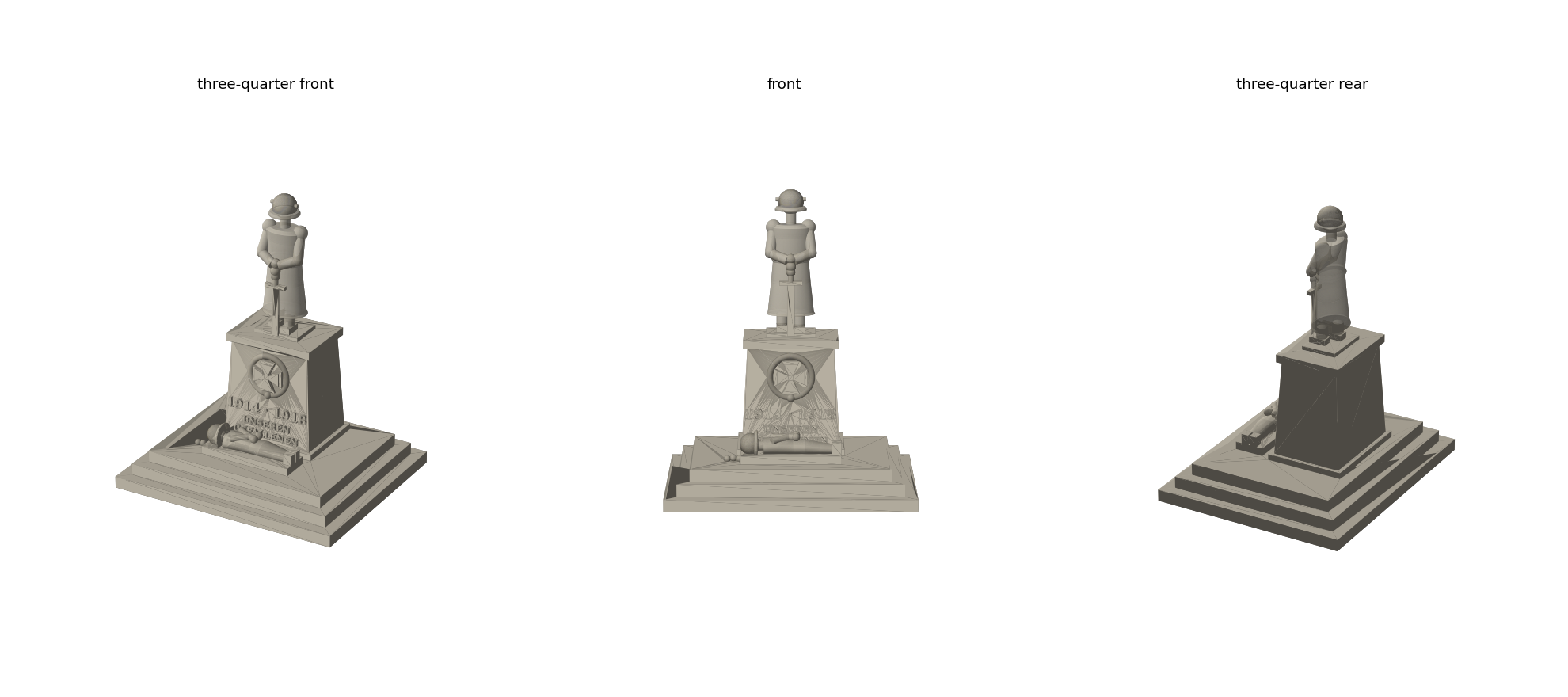
2D images of the 3D model generated by Claude.
Selected scholarship and sources
Monographs and articles the analysis rests on (all from prior knowledge; verify editions before citing):
- George L. Mosse, Fallen Soldiers: Reshaping the Memory of the World Wars (Oxford, 1990) — the “Myth of the War Experience” and the cult of the fallen.
- Meinhold Lurz, Kriegerdenkmäler in Deutschland, 6 vols (Heidelberg, 1985–87), esp. vol. 4 Weimarer Republik — the standard typology (sentry, fist, sleeping dead, Sturmtrupp).
- Sabine Behrenbeck, Der Kult um die toten Helden: Nationalsozialistische Mythen, Riten und Symbole 1923 bis 1945 (Vierow, 1996).
- Reinhart Koselleck and Michael Jeismann (eds), Der politische Totenkult: Kriegerdenkmäler in der Moderne (Munich, 1994).
- Stefan Goebel, The Great War and Medieval Memory: War, Remembrance and Medievalism in Britain and Germany, 1914–1940 (Cambridge, 2007) — swords, knights and the medieval frame.
- Jay Winter, Sites of Memory, Sites of Mourning (Cambridge, 1995) — mourning versus heroic idioms.
- Thomas Kühne, Kameradschaft: Die Soldaten des nationalsozialistischen Krieges und das 20. Jahrhundert (Göttingen, 2006) and The Rise and Fall of Comradeship (Cambridge, 2017).
- Sabine Kienitz, Beschädigte Helden: Kriegsinvalidität und Körperbilder 1914–1923 (Paderborn, 2008) — the disabled body against the memorial body.
- Karen Hagemann and Stefanie Schüler-Springorum (eds), Home/Front: The Military, War and Gender in Twentieth-Century Germany (Oxford, 2002); Ute Frevert, A Nation in Barracks (Oxford, 2004).
- Klaus Theweleit, Männerphantasien (1977–78; English Male Fantasies, 1987–89).
- Loretana de Libero, Rache und Triumph: Krieg, Gefühle und Gedenken in der Moderne (Munich, 2014) — the clenched-fist type.
- Gerhard Armanski, “… und wenn wir sterben müssen”: Die politische Ästhetik von Kriegerdenkmälern (Hamburg, 1988).
- Volker Ackermann, Nationale Totenfeiern in Deutschland (Stuttgart, 1990).
Web sources opened for this document (as of 19 September 2026): Kriegerdenkmal im Hofgarten (Munich); Weinheimer Kriegerdenkmal; Stadt Münster, “Stehender Soldat”; Stadt Münster, Dreizehner-Denkmal; Gedenkstätten in Hamburg, 31er-Denkmal; Kunst@SH, Plön; Stadtwiki Karlsruhe, Berghausen; Rheinpfalz, Weltkriegsdenkmäler in der Pfalz; museum-digital, Burg (Spreewald); museum-digital, Berlin-Mariendorf; Kriegerdenkmal (German Wikipedia overview). Wikipedia links for Barlach, Lehmbruck, Kollwitz, Elkan, Niedersachsenstein, Tannenberg, Neue Wache and the Dammtor memorial are given inline above and were not separately opened.